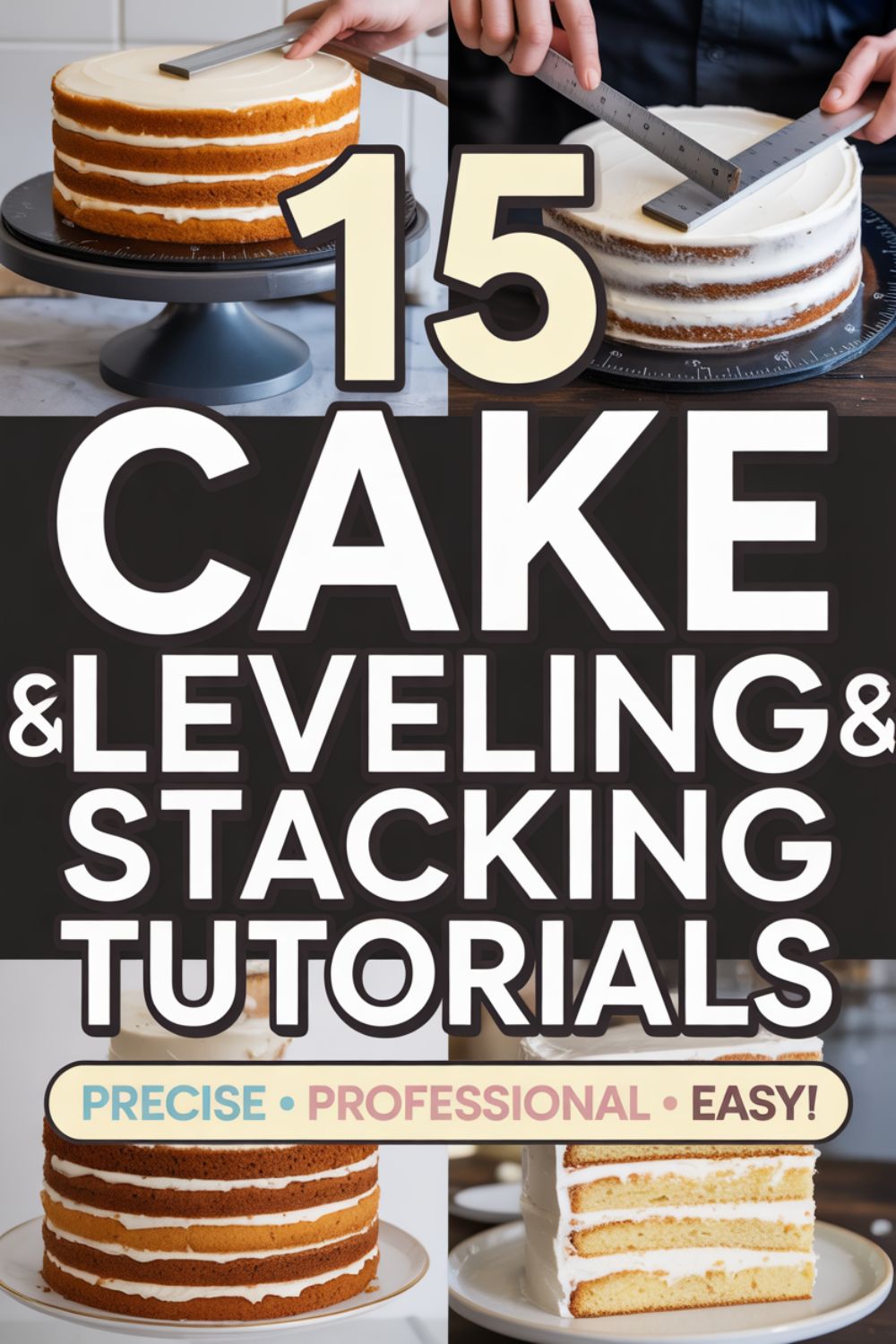
15 Cake Leveling & Stacking Tutorials That’ll Make You Look Like a Pro
Look, I’ve wrecked more cakes trying to stack them than I care to admit. That lopsided birthday cake? Yeah, that was me. The wedding cake that looked drunk? Also me. But here’s the thing—cake leveling and stacking isn’t some dark art reserved for pastry school graduates. It’s a learnable skill, and honestly, once you nail a few key techniques, you’ll wonder why it ever seemed hard.
Whether you’re stacking layers for a simple birthday celebration or attempting your first multi-tiered masterpiece, these 15 tutorials will walk you through everything from getting perfectly flat tops to building cakes that actually stay upright. No culinary degree required, just a willingness to get a little messy and maybe eat some cake scraps along the way (baker’s tax, you know).
Why Leveling Actually Matters (Spoiler: It’s Not Just About Looking Pretty)
Here’s something nobody tells beginners: that dome on top of your cake isn’t cute, and it’s definitely not helping you. When cakes bake, the center rises last and highest, creating that rounded top. Seems harmless, right?
Wrong. Try stacking three domed cakes and you’ll end up with the Leaning Tower of Pisa, except made of butter and sugar. Level cakes stack evenly, frost smoothly, and—most importantly—don’t collapse halfway through your cousin’s graduation party. Plus, according to professional cake decorators at Wilton, leveling creates a stable foundation that makes every subsequent decorating step exponentially easier.
I learned this the hard way when I tried to frost an unleveled cake. The frosting just… slid. Like a tiny, delicious avalanche. Not my finest moment.
Tutorial 1: The Classic Serrated Knife Method
This is where everyone starts, and honestly, it’s all you really need for basic layer cakes. Grab a long serrated bread knife—the longer, the better. Let your cake cool completely (warm cake + knife = crumbly disaster), then place it on a flat surface.
Here’s the technique: Place your non-dominant hand gently on top of the cake to steady it. With your dominant hand, position the knife where the dome begins to rise. Use a gentle sawing motion, cutting about an inch into the cake. Then—and this is key—rotate the cake about 45 degrees and continue sawing. Keep turning and slicing until you’ve cut all the way around. The domed top should lift right off.
When This Method Works Best
Perfect for single-tier cakes or when you’re just starting out. It’s free (assuming you own a bread knife), requires no special equipment, and once you get the feel for it, takes maybe two minutes per layer. The main challenge? Keeping your hand steady and the knife level. It takes practice, but so does everything worth doing.
Tutorial 2: Toothpick Guideline Technique
Want more precision without buying extra tools? This is your method. Grab four toothpicks and a ruler. Measure how high you want your leveled cake to be—let’s say 2.5 inches. Insert toothpicks at that exact height at 12, 3, 6, and 9 o’clock positions around your cake, pushing them about halfway in.
Now when you use your serrated knife, the toothpicks act as a cutting guide. Your knife rides along the toothpicks, ensuring you’re cutting at the same height all the way around. It’s like training wheels for cake leveling, except the training wheels are edible and you’re less likely to skin your knee.
If you’re working with cakes that need extra stability, you might also love these moist cake recipes that hold up beautifully during leveling.
Tutorial 3: The Cake Leveler Tool Method
Alright, so you’ve decided to invest in an actual cake leveler tool. Smart move. These U-shaped tools with an adjustable wire make leveling almost foolproof. Set the wire to your desired height using the notches on the sides, place it over your cake, and pull it through in one smooth motion.
The wire slices through butter-soft cake like, well, a hot knife through butter. According to baking experts at Bob’s Red Mill, cake levelers are especially useful for achieving consistent results across multiple cakes. I use mine constantly now, but full disclosure: I still eat the scraps.
The Investment Question
Cake levelers typically run between $10-$25. Is it worth it? If you’re baking cakes more than twice a year, absolutely. If this is a one-time birthday cake situation, stick with the knife method and save your money for sprinkles.
Tutorial 4: Dental Floss Trick (No, Really)
This sounds absurd until you try it. Unflavored dental floss works shockingly well for leveling cakes. Slide a long piece of floss horizontally into the side of your cake, cross the ends, and pull. The floss cuts through the cake in one clean motion with zero crumbs.
The catch? Your cake needs to be fairly soft, and you need steady hands. But for traveling or when you’re away from your regular tools, this works in a pinch. Just make sure it’s unflavored floss—nobody wants a minty chocolate cake. Trust me on this one.
Tutorial 5: The Sheet Pan Shortcut
Here’s a completely different approach: skip the leveling altogether by baking thinner layers from the start. Pour your batter into rimmed sheet pans about half an inch to one inch thick. These thin layers bake flat naturally because there’s less batter to create that dome effect.
Once cooled, use a round cake pan or cookie cutter to cut out perfect circles. You’ll get multiple layers from one sheet pan, and they’re already level. The downside? You need more layers to achieve the same height, but some bakers (myself included) actually prefer this because more layers mean more frosting between them.
Speaking of creative approaches, these sheet pan cake recipes are designed specifically for this method.
Cake Leveling Essentials That Actually Make a Difference
After testing way too many tools, here’s what actually earned permanent spots in my kitchen:
Physical Tools:
- Ateco Cake Leveler – Adjustable notches, sturdy wire, doesn’t bend when you actually need it to work
- Wilton Rotating Cake Stand – Makes leveling and frosting exponentially easier, spins smoothly even when loaded with a heavy cake
- 12-inch Serrated Bread Knife – Long enough to cut through even large cakes in one pass, keeps a sharp edge
Digital Resources:
- Complete Cake Decorating Video Course – Step-by-step tutorials covering everything from basic leveling to advanced stacking techniques
- Printable Cake Measurement Guide – Charts for standard cake sizes, batter amounts, and leveling heights
- Professional Baker’s Troubleshooting eBook – Fixes for every common cake disaster, because we’ve all been there
Tutorial 6: The Cake Strip Hack for Level Baking
Let’s back up a second. What if you could bake level cakes from the start? That’s where cake strips come in—or their DIY alternative. These fabric strips wrap around your cake pan, get soaked in water, and insulate the sides while baking.
Why does this matter? The edges of cake bake faster than the center, causing that dome. When you insulate the sides with wet strips, everything bakes at the same rate, and you get a flat top. Less leveling needed = less cake wasted = more cake in your face. The math checks out.
Don’t have cake strips? Cut an old kitchen towel into strips about the height of your pan and secure them with metal binder clips. Yes, metal clips are oven-safe. No, I don’t know why this surprises people.
Tutorial 7: Eye-Level Stacking for Straight Sides
Alright, your cakes are leveled. Now comes the stacking, which is where things can go sideways fast—literally. The secret? Get down to eye level with your cake as you stack. Seriously. Bend down and look at those layers from the side.
Place your first layer on a cake board or turntable. Add your frosting or filling. Set the next layer on top, press gently, then—this is crucial—check from eye level that it’s aligned with the layer below. If it’s crooked, fix it now. Once you’ve added the next layer of frosting, adjustments become messy.
The “Press and Check” Method
After placing each layer, gently press down with your palm to ensure good contact with the frosting below. Then rotate your turntable slowly while viewing from eye level. Any wobbles or lean become immediately obvious. According to professional cake decorator Tessa Huff, this simple eye-level check prevents 90% of stacking problems before they become unfixable.
If you’re working with particularly delicate layers, these classic pound cake recipes offer more structural stability.
Tutorial 8: The Buttercream Dam Technique
Ever had filling squish out the sides of your cake? Annoying, right? The buttercream dam prevents this. Using a piping bag fitted with a plain tip, pipe a ring of buttercream around the outer edge of your cake layer. This ring acts as a barrier.
Now you can add jam, curd, mousse, or whatever filling you want inside that ring without it escaping. The frosting-to-filling ratio matters here—if your cake layers are 1.5 inches tall, your buttercream dam should be about 0.75 inches tall. A 2:1 ratio prevents overflow while still giving you plenty of filling.
I use this technique religiously now. My previous method of “just pile it on and hope” resulted in more jam on my counter than between my cake layers.
Tutorial 9: Chilling Between Layers
Here’s something that changed my cake game: stick your stacked layers in the fridge for 15-20 minutes between major steps. Just leveled your cakes? Chill them. Just stacked two layers? Chill them. About to add your final layer? You guessed it.
Cold buttercream firms up, which stabilizes everything. Cold cake is less likely to crack or shift. You’ll have an easier time handling it, and your finished product will be structurally sounder. The only downside is waiting, but I usually use that time to clean up or stress-eat more cake scraps.
For more time-saving strategies, check out these one-bowl cake recipes that simplify the entire process.
Tutorial 10: Dowel Rod Support for Multi-Tier Cakes
Single-tier cakes can get away with just frosting between layers. Multi-tier cakes? They need structural support or they’ll collapse under their own weight. That’s where dowel rods come in—plastic or wooden rods that you insert into the bottom tier to support the tier above.
Here’s the process: Place your bottom tier on its cake board. Gently press the cake board from your second tier onto the top of the bottom tier to create an imprint. Use this circle as your guide for placing dowels. Insert 3-4 dowels evenly spaced around this circle, about 1.5 inches from the edge.
Cutting Dowels to Size
This part’s important: Your dowels need to be exactly the height of the cake they’re supporting, no taller. Insert one dowel, mark where it meets the top of the cake with a pen, pull it out, and cut it at that mark. Use this first dowel as a template for cutting the rest to the same length.
Some bakers swear by bubble tea straws instead of wooden dowels. They’re thicker than regular straws, easier to cut, and you don’t risk wooden splinters in your cake. IMO, they work better for smaller tiers.
Tools & Resources That Make Stacking Easier
These aren’t all essential, but they’ve saved me from countless cake disasters:
Physical Products:
- Wilton Cake Dowel Rods – Cut cleanly, don’t splinter, support serious weight without bending
- Ateco Offset Spatula Set – Multiple sizes for different tasks, perfectly angled for smooth frosting
- Wilton Cake Boards Pack – Pre-cut to standard sizes, sturdy enough for transport
Digital Downloads:
- Multi-Tier Cake Construction Guide PDF – Diagrams showing exactly where to place dowels for different cake sizes
- Cake Stacking Checklist Printable – Step-by-step checklist so you don’t forget crucial steps mid-project
- Emergency Cake Fixes Video Series – Because sometimes things go wrong and you need answers fast
Tutorial 11: The Crumb Coat Foundation
Before you apply your final frosting, you need a crumb coat. This is a thin layer of frosting that traps all the loose crumbs so they don’t show up in your final coat. Think of it as primer for your cake.
Apply a very thin layer of frosting all over your stacked cake using an offset spatula. It doesn’t need to look pretty—it just needs to stick to the cake and trap crumbs. Then refrigerate for 20-30 minutes until firm. Your final frosting will glide on smoothly over this sealed surface.
I used to skip this step to save time. I learned quickly that spending 10 minutes on a crumb coat saves you 30 minutes of trying to fix a crumb-covered final coat. Do the math.
Want to explore different cake types that work beautifully with this technique? Try these unique cake flavors or these red velvet variations.
Tutorial 12: Turntable Technique for Even Frosting
A rotating cake turntable might seem like a luxury, but it’s one of those tools that immediately proves its worth. Place your stacked cake on the turntable. Hold your offset spatula or bench scraper at a consistent angle against the side of the cake, then slowly rotate the turntable.
The turntable does the work of moving the cake past your stationary tool, which creates much smoother sides than trying to move the spatula around a stationary cake. Your tool stays still, the cake rotates—this is the secret to professional-looking cakes at home.
The Water Spray Trick
Here’s something I learned from a professional baker: Once you’ve got your frosting applied, lightly spray the cake with clean water from a food-safe spray bottle. Then take your bench scraper and go over the surface one more time while rotating the turntable. The water helps smooth out any remaining bumps and ridges.
Sounds weird, works perfectly. The first time I tried this, I was convinced I’d ruin the cake. Instead, I got the smoothest sides I’d ever achieved.
Tutorial 13: Fixing Gaps and Uneven Spots
Even with perfect technique, you’ll sometimes notice gaps where tiers meet or uneven spots in your frosting. Don’t panic. Two simple fixes handle most problems.
For small gaps between tiers, pipe matching buttercream into the gap using a small offset spatula to blend it smoothly into the surrounding frosting. For a more decorative approach, pipe a border using a star tip around the base of each tier. This not only covers gaps but adds a professional-looking detail.
Uneven spots in your frosting? Add a bit more frosting to the low areas, then use your offset spatula while rotating the turntable to blend and smooth. Working with the turntable moving makes blending much easier than trying to patch stationary spots.
Looking for more decorating ideas? These frosting recipes offer different textures and flavors that work well with various stacking techniques.
Tutorial 14: The Center Dowel for Extra Stability
For tall cakes or cakes you’re transporting, add one final layer of security: a center dowel that runs through all tiers. After stacking your entire cake, take a long wooden dowel (not a straw this time—you need the strength) and sharpen one end with a knife or pencil sharpener.
Push this sharpened dowel straight down through the center of all tiers, from top to bottom. It should pierce through all the cake boards and go all the way into the bottom tier. This prevents any shifting during transport and adds incredible stability.
Cut off any excess dowel sticking out the top, then cover the hole with a decoration—a flower, a cake topper, whatever fits your design. Nobody will ever know it’s there, but your cake will stay put even during bumpy car rides.
Tutorial 15: Assembly Order for Complex Designs
When you’re building a show-stopping cake with multiple tiers, different fillings, and various decorations, order of operations matters. Here’s the sequence that prevents the most headaches:
- Bake and cool all layers – Get everything baked a day ahead if possible
- Level all layers – Do all your leveling in one session
- Fill and stack individual tiers – Complete each tier separately before combining
- Crumb coat each tier – Chill after crumb coating
- Final frost each tier – Make them beautiful before stacking
- Stack tiers with dowel support – Now combine tiers with proper support
- Add final decorations – Borders, flowers, toppers come last
Trying to decorate before stacking makes everything harder. Stacking before crumb coating means you’ll get crumbs in your final coat. Following this order saves time and frustration.
For special occasions, these celebration cake ideas and DIY wedding cake ideas show how these techniques come together in stunning designs.
The Make-Ahead Strategy
Professional bakers don’t decorate cakes the day they’re serving them—too stressful. Bake your cakes 1-2 days ahead, wrap tightly in plastic wrap, and refrigerate or freeze. Wrapped cakes actually stay more moist than freshly baked ones. Decorate the day before serving, and you’ll actually enjoy the process instead of stress-eating frosting at 2 AM.
Sarah from our community tried this timeline for her daughter’s birthday and said it completely changed her baking stress levels. She actually slept the night before the party instead of panicking over a tilting cake at midnight.
Frequently Asked Questions
Should I level my cake when it’s warm or cold?
Always level a completely cooled cake. Warm cake is soft and crumbly, making clean cuts nearly impossible. For even better results, chill your cake in the fridge for 30 minutes before leveling—cold cake cuts cleanly with minimal crumbs. If you’re really organized, wrap your layers in plastic and freeze them overnight, then level while still frozen for the cleanest cuts possible.
How many dowel rods do I need for a two-tier cake?
For most two-tier cakes, you’ll need 3-4 dowels in the bottom tier. Arrange them in a circle about 1.5 inches inside where your second tier will sit. For bottom tiers larger than 12 inches, add 2-3 additional dowels toward the center for extra support. The weight of your upper tier and how far you’re transporting the cake should guide your decision—when in doubt, add an extra dowel.
Can I stack cakes without a turntable?
Absolutely, though it’s harder. Place your cake on a flat plate or cake board that you can physically lift and rotate by hand. The key is being able to view and work on all sides evenly. A turntable just makes the rotation smoother and more controlled, which results in more even frosting and straighter sides, but it’s not mandatory for successful stacking.
What’s the best frosting for stacking cakes?
American buttercream and Swiss meringue buttercream both work excellently because they firm up when chilled, providing stability. Ganache is even sturdier and creates very stable layers. Avoid whipped cream frostings or anything too soft for structural layers—save those for single-tier cakes or as decorative elements only.
How far in advance can I stack a layered cake?
You can stack and frost a cake 1-2 days before serving if stored properly in the refrigerator. The flavors actually develop and improve, and the structure becomes more stable as everything sets. Just keep it covered to prevent drying out, and bring it to room temperature for about an hour before serving for the best texture and flavor. Fondant-covered cakes can be stacked even earlier—up to a week in advance.
You’ve Got This
Look, I’m not going to lie and say your first stacked cake will be perfect. Mine looked like it survived an earthquake. But you know what? It still tasted amazing, and everyone at the party was impressed anyway. The second one was better. The tenth one looked actually professional.
Cake leveling and stacking is genuinely just practice. These 15 techniques give you multiple approaches to try, different tools to experiment with, and solutions for the problems you’ll inevitably face. Some methods will click immediately. Others won’t feel right until you’ve done them a few times.
Start simple—maybe just a two-layer cake with basic leveling. Get comfortable with that. Then add a third layer. Then try a crumb coat. Work your way up to dowels and multi-tier constructions. There’s no rush. Every cake you make teaches you something, even if what it teaches you is “don’t try to frost a warm cake” (speaking from experience here).
The beautiful thing about cake? Even when it’s slightly crooked or the frosting isn’t perfectly smooth, it still tastes delicious. And honestly, that’s what matters most. Everything else is just details.